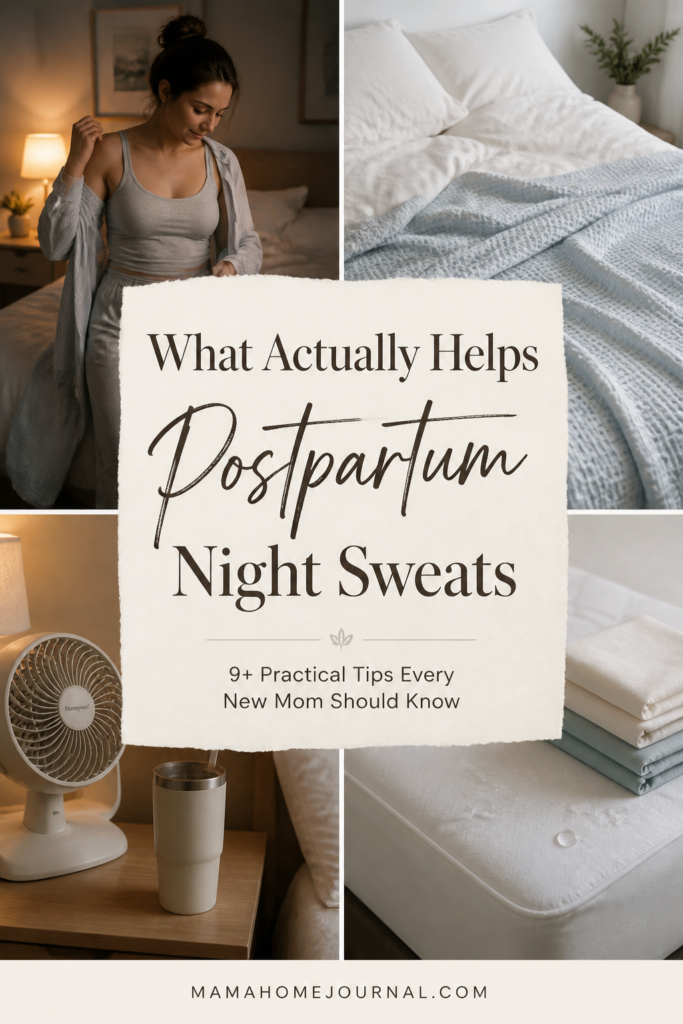
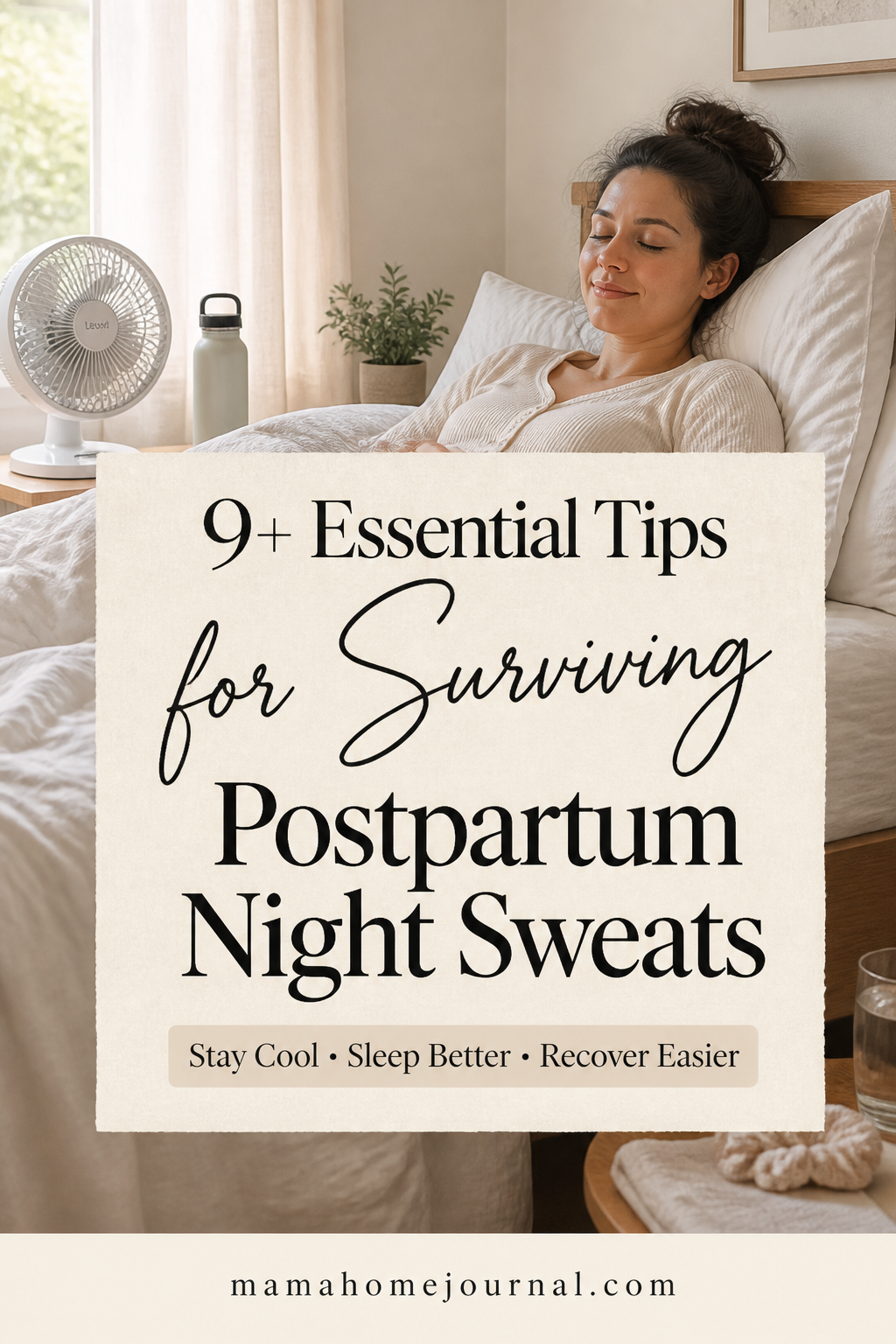
9+ Essential Tips for Surviving Postpartum Night Sweats
Postpartum night sweats got you completely soaked and absolutely exhausted? You are not alone — and there is genuinely a way through this. Let’s talk about how to survive it.
So. You made it through an entire pregnancy.
You pushed through contractions that felt like they could shatter mountains.
You delivered an entire human being into the world.
You are a literal superhero.
And now — all you want, more than anything in the universe — is to enjoy even one single night where you are not waking up completely drenched, sheets soaked, wondering what on earth is happening to your body.
I hear you. I have been exactly there. And I have some tips that genuinely helped me survive the postpartum night sweats stage with at least a shred of my sanity intact.
Let’s get into it —
This post contains affiliate links. As an Amazon Associate I earn from qualifying purchases — at no extra cost to you. Thanks for supporting Mama Home Journal!

Why Do Postpartum Night Sweats Happen?
Before we get into survival mode, it helps to understand what is actually going on in your body. After you give birth, your estrogen and progesterone levels drop significantly and rapidly. Your body also needs to shed all of the extra fluid it retained during pregnancy — and night sweats are one of the main ways it does exactly that.
The result? Your body essentially running its own internal furnace while you are trying to sleep. Postpartum night sweats are extremely common, typically most intense in the first two to four weeks after delivery, and they are absolutely temporary — even when it feels like they will never end.
Now, here is everything that actually helped me get through it:
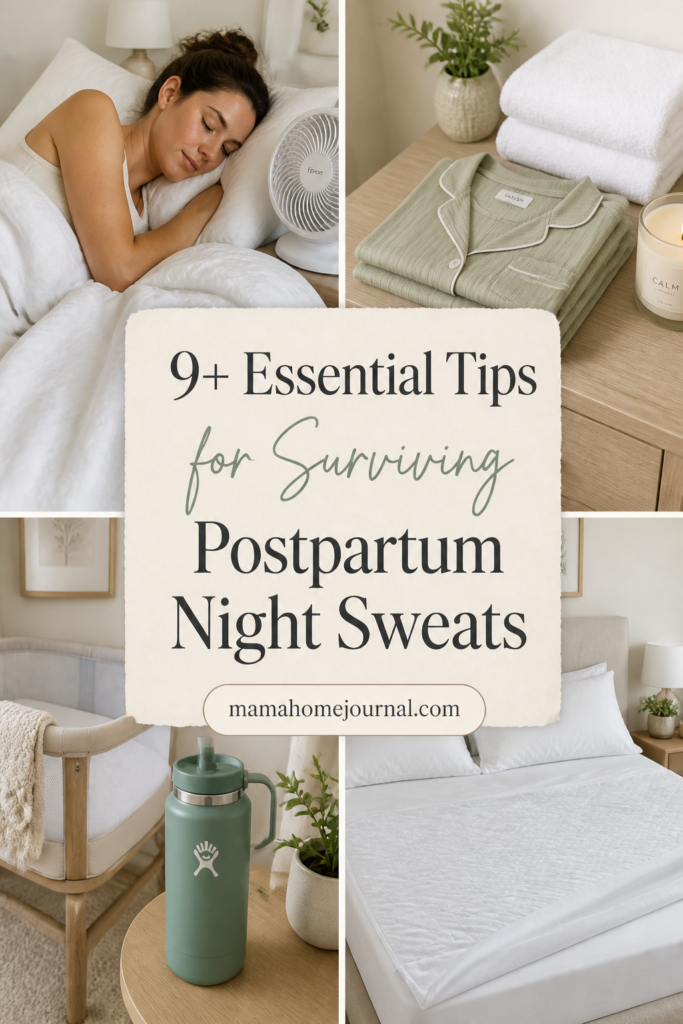
How to Survive Postpartum Night Sweats
01. Dress as Lightly as Possible
Honestly? The easiest solution is to just sleep naked. No fabric, no trapped heat, no soaked pyjamas to wrestle off at 3 AM while your baby is screaming and you are half asleep. If that is genuinely not your comfort zone, then dress as lightly as you possibly can.
Tank tops are significantly more comfortable than long-sleeve pyjama tops, and loose shorts are far easier to deal with than pants. Choose pyjamas with minimal coverage and prioritize fabrics that are lightweight and genuinely breathable — bamboo and cotton are both excellent choices because they wick moisture away from your skin rather than trapping it against your body. Avoid anything synthetic, anything tight, and anything with long sleeves or long pants.
02. Stash Backup Pyjamas in Your Nightstand
If you are already in the thick of postpartum night sweats, you know exactly how uncomfortable it is to wake up for a nighttime feed or diaper change with completely soaked pyjamas clinging to your skin. It is miserable, and it makes an already exhausting middle-of-the-night wake-up feel ten times worse.
The solution that worked brilliantly for me was keeping a small pile of clean, dry backup tops in my bedside drawer every single night before bed. Baggy old t-shirts and soft tank tops work perfectly for this — I raided my husband’s old t-shirt collection and ended up with the most comfortable, breathable sleep tops imaginable at literally zero cost. Each night before getting into bed, I would stack three or four clean options in the drawer so that switching in the middle of the night required minimal effort and zero searching around in the dark.
03. Invest in a Mattress Protector Immediately
Your mattress is an investment worth protecting — and postpartum night sweats can do real damage to an unprotected mattress very quickly. A thin, waterproof mattress protector goes between your mattress and fitted sheet and creates a barrier that keeps moisture from soaking through.
This mattress is one of those purchases that feels slightly unnecessary until the first night you wake up completely drenched and realize your mattress would have been absolutely saturated without it. Get one before the sweats begin. You will thank yourself every single morning.
04. Use an Extra Set of Throw-Away Fitted Sheets
Here is a practical tip that makes a real difference in the middle of the night. Keep an extra fitted sheet layered directly on top of your regular fitted sheet so that if you wake up and the top sheet is completely soaked, you can strip it off and there is a clean, dry sheet already underneath. No remaking the entire bed at 2 AM. No sleeping on a bare mattress. Just pull off the top layer and you are back to a clean sleeping surface in about thirty seconds.
If you follow the timeless advice of sticking to all-white bedding — which makes everything so much easier to wash and keep bright — having a few extra plain white fitted sheets on rotation means you always have backups ready and laundering them is completely straightforward.
05. Swap to a Light Blanket
Your beautiful duvet is not going to survive postpartum night sweats intact if you keep sleeping with it through this phase. The wiser approach — and the one that will save your good bedding — is to temporarily swap your regular duvet for an old spare one from the back of the closet, or switch to a single lightweight blanket that you can throw in the wash without any stress.
During my worst weeks of postpartum night sweats, I used the following rotation: the first time I woke up drenched in the night, I would flip the blanket over so the damp side faced outward. The second time I woke up, I would move that blanket to the floor and pull out the fresh backup blanket I had positioned at the foot of the bed. It sounds fussy written out but in practice it became completely automatic and made a real difference to my comfort level throughout the night.
One more thing worth mentioning — my husband and I both slept under separate blankets during the height of the night sweats so that my constantly changing and adjusting bedding situation did not disturb his sleep every single time.
06. Keep a Clean Towel Right Beside Your Bed
This is such a small thing but it made a surprisingly big difference to how I felt waking up in the middle of the night soaked through. Keeping a clean, dry towel folded on my bedside table meant I could quickly dry off before switching into fresh pyjamas without having to fumble around looking for anything.
It takes about five extra seconds to grab a towel before you go to bed and set it somewhere immediately accessible. Those five seconds are worth it every single time.
07. Prioritize a Morning Shower
Making a quick morning shower a non-negotiable part of my postpartum routine was genuinely one of the things that helped me feel most like a functional human being during the night sweats phase. After a night of repeatedly waking up sweaty and exhausted, a quick rinse first thing in the morning felt completely restorative — even if it was only five minutes long.
My husband knew that the morning shower was part of my daily reset, so he would take the baby during that window so I could have those few minutes to myself. If you have a partner or support person at home, communicate this need clearly. It is not a luxury — it is a basic part of taking care of yourself so you can take care of your baby.
08. Stay Seriously Hydrated
All of that sweating pulls a significant amount of water out of your body every single night — and replacing those fluids throughout the day is genuinely important, not optional. Dehydration makes every aspect of new parenthood harder: your energy levels, your mood, your recovery, and your ability to function on very little sleep.
For breastfeeding mamas, staying hydrated is even more critical because your body requires adequate fluid intake to maintain your milk supply. Aim to drink water consistently throughout the day rather than trying to catch up all at once. A large insulated tumbler with a straw that you can sip from one-handed while feeding your baby in the middle of the night is genuinely one of the most practical postpartum investments you can make.
09. Cool Your Bedroom Down Before Bed
Lowering the temperature of your bedroom environment before you go to sleep sets you up for the most comfortable night possible given the circumstances. Run a fan directed at your side of the bed, crack a window if the outdoor temperature allows for it, or turn down the air conditioning before your bedtime routine begins.
A fan is particularly helpful because it provides both cooling air movement and a gentle white noise effect that can help both you and your baby sleep more soundly. Even a modest drop in room temperature makes a noticeable difference to how intensely the night sweats affect your sleep — the cooler the room, the less dramatically your body temperature swings during the night.
10. Talk to Your Doctor If the Sweats Feel Extreme
Postpartum night sweats are normal and extremely common, but there is a point at which sweating that feels severe or is accompanied by other symptoms — fever, unusual fatigue, rapid heart rate, or symptoms that persist well beyond the four to six week mark — warrants a conversation with your healthcare provider.
Most of the time, postpartum night sweats resolve on their own as your hormones stabilize and your body finishes shedding retained fluids. But you know your body, and if something feels off beyond the ordinary discomfort of this phase, please do not hesitate to bring it up with your OB, midwife, or GP. You are not being dramatic. You are being appropriately attentive to your postpartum health.
Postpartum Night Sweats — The Short Version
Growing, carrying, and delivering an entire human being is one of the most physically extraordinary things a body can do. Is it really any surprise that the recovery process involves a few deeply uncomfortable phases?
Postpartum night sweats are genuinely one of the more unpleasant parts of the fourth trimester — but they are also temporary. For most mamas, they ease significantly within the first few weeks and resolve completely within the first couple of months as hormone levels stabilize.
In the meantime, dress lightly, protect your mattress, layer your bedding for easy middle-of-the-night changes, keep your room cool, drink your water, and be patient with your incredible body. You have got this — even when it feels very much like you are melting.