
250+ Most Beautiful Evergreen Baby Names That Never Date (2026 Ultimate Guide)
The oldest surviving list of recorded names is a clay tablet from Mesopotamia, roughly 2400 BCE. Most of those names are unpronounceable now — linguistic fossils from a world that no longer exists. But a handful of root forms still show up at birth registries today: early versions of Miriam, Naomi, Solomon. That is approximately 4,400 years of wear-testing, and they are still going. That is what evergreen means for a name — not just “popular right now,” but structurally sound across centuries.
What makes a name last is not mystery or magic. It is phonetic stability combined with genuine cultural depth. Names tied to a specific decade’s sound trend — the rhyming wave of Aiden, Jayden, Brayden, Kayden — rise and fall together because they are borrowing from a moment. Names rooted in scripture, classical mythology, or great literature have ballast. They have been through plagues, wars, fashion revivals, and generations of toddlers who could not quite pronounce them, and they came out fine.
This list pulls from eight different wells: the core English classics that have held rank for a millennium; the punchy one-syllable names that wear well on anyone; the ancient and biblical names that feel both old-world and completely current; the literary choices that carry a whole story; the melodic long-form names that still feel graceful decades later; the nature-rooted names with real staying power; the under-the-radar gems that have never quite broken through but have also never once been wrong; and the cross-cultural names that exist in a dozen languages without changing.
When referencing popularity, all rankings reference the United States Social Security Administration baby name data for 2025, the most current year available.
These 250+ names work right now. And they will still work when your child is filling out college applications, running a meeting, or introducing themselves to their own children’s teachers. Pick the one that sounds like yours.

What Makes a Name Truly Evergreen?
Before the names — a brief framework that explains why some names outlast their era and most do not.
Phonetic stability. An evergreen name does not rely on a sound trend. It does not rhyme with five other names from the same decade. It does not depend on a vowel combination that only sounds current in a specific era. James, Eleanor, Miriam, and Felix have sounds that belong to no particular moment — which is why they belong to every moment.
Cultural depth. Evergreen names are rooted in scripture, classical mythology, literature, or history. That depth gives them weight that outlasts any single generation’s taste. A name carried by an archangel, a Shakespearean heroine, a Roman emperor, or a biblical patriarch has already survived more than any trend cycle could throw at it.
Adaptability. The best evergreen names age through every stage of life without strain. They sound appropriate on a three-year-old and distinguished on a sixty-year-old. They have natural nickname forms that give their wearers options. And they read clearly across cultures without requiring constant explanation.
The Pillars — Classics That Have Never Left
These names have sat at or near the top of birth records in the English-speaking world for five centuries or more. Not flashy. Just structurally, permanently perfect.
Elizabeth
- ORIGIN: Hebrew
- MEANING: “pledged to God”
- POPULARITY: #17
Sixteen centuries of queens, saints, writers, and ordinary women — no single nickname owns it, which means it is always adaptable. Beth, Eliza, Libby, and Bess are all living comfortably inside it.
James
- ORIGIN: Hebrew
- MEANING: “supplanter”
- POPULARITY: #5
One of the most consistently ranked names in the English-speaking world since records began — steady without being boring, distinguished without being grand.
Margaret
- ORIGIN: Greek via Latin
- MEANING: “pearl”
- POPULARITY: #119
The full form feels formal and grand — Maggie, Meg, Margo, and Gretel are all living inside it, giving it more everyday range than almost any other name on this list.
Thomas
- ORIGIN: Aramaic
- MEANING: “twin”
- POPULARITY: #39
The apostle’s name has sat at the top of historical frequency charts for a thousand years. Tom is the everyday form — Thomas is the name that earns it.
Catherine
- ORIGIN: Greek
- MEANING: “pure”
- POPULARITY: #320
The C spelling has been used by empresses, martyrs, and writers across eight centuries without missing a single generation. Cate, Cat, and Kitty are all inside it.
William
- ORIGIN: Old German
- MEANING: “resolute protector”
- POPULARITY: #10
Has not fallen out of the top ten in most English-speaking countries for five hundred years. Will, Bill, and Liam all emerged from this single root.
Anne
- ORIGIN: Hebrew
- MEANING: “grace, favor”
- POPULARITY: #649
Three letters that have never been out of circulation. Spare but never plain — serious without effort, complete without needing anything added.
Charles
- ORIGIN: Old German
- MEANING: “free man”
- POPULARITY: #51
Royal, literary, and deeply familiar all at once — it works in every register without strain. Charlie is the warm everyday form waiting inside.
Mary
- ORIGIN: Hebrew
- MEANING: “beloved; wished-for child”
- POPULARITY: #132
The most common female name in the Western world for centuries. Underused now, which means it is quietly, genuinely fresh again for the first time in a generation.
Henry
- ORIGIN: Old German
- MEANING: “home ruler”
- POPULARITY: #6
Seven English kings, three French ones, and a steady presence at birth registries from 1200 to the present. Harry is the warm everyday form inside it.
Eleanor
- ORIGIN: Old French/Occitan
- MEANING: “shining light”
- POPULARITY: #14
From Eleanor of Aquitaine to Eleanor Roosevelt — the name carries real stature without trying, and Nell or Ellie are both wonderful everyday forms.
Robert
- ORIGIN: Old German
- MEANING: “bright fame”
- POPULARITY: #90
Robbie, Rob, and Bob — it adapts to whoever is wearing it, which is part of why it has been popular for nine hundred years without interruption.
Helen
- ORIGIN: Greek
- MEANING: “torch; bright, shining one”
- POPULARITY: #424
Mythologically enormous and practically useful — always sounds educated without performing, classical without effort.
Arthur
- ORIGIN: Celtic/Latin
- MEANING: “bear; possibly from the Roman Artorius”
- POPULARITY: #105
The legend keeps it warm — the sound keeps it wearable on a real child, which is the exact combination every evergreen name needs.
Frances
- ORIGIN: Latin
- MEANING: “free; from France”
- POPULARITY: #379
The feminine form of Francis — quieter than Francesca but no less elegant, and Frankie is a completely wonderful everyday nickname.
Richard
- ORIGIN: Old German
- MEANING: “brave ruler”
- POPULARITY: #232
Dickon, Richie, and Rich — a medieval name with multiple lives and a clean, confident sound that belongs to no single decade.
Alice
- ORIGIN: Old German
- MEANING: “noble; of noble kind”
- POPULARITY: #62
Popular for centuries before Lewis Carroll — the fairy-tale association has not dated it, just added another layer of beautiful texture.
Edward
- ORIGIN: Old English
- MEANING: “wealthy guardian”
- POPULARITY: #228
Ned, Ed, and Eddie — sturdy, never fussy, never out of fashion in any era it has been carried through.
Grace
- ORIGIN: Latin
- MEANING: “God’s favor; charm”
- POPULARITY: #40
A virtue name that wears effortlessly on a real person — nobody has to explain it and everybody immediately understands it.
George
- ORIGIN: Greek
- MEANING: “farmer; tiller of the earth”
- POPULARITY: #124
Royal and blue-collar at the same time — that combination is part of its enduring, irreplaceable magic.
Clara
- ORIGIN: Latin
- MEANING: “bright, clear”
- POPULARITY: #78
A close cousin of Claire, slightly warmer — the German and Slavic worlds have kept it alive without interruption for over a millennium.
Dorothy
- ORIGIN: Greek
- MEANING: “gift of God”
- POPULARITY: #431
Carried the whole twentieth century by Oz — now feels genuinely vintage and fresh rather than retro, and Dot or Dottie are completely charming.
Rose
- ORIGIN: Latin
- MEANING: “rose flower”
- POPULARITY: #115
Appears in heraldry, Shakespeare, and your neighbor’s daughter — it simply works in every single context without exception.
Edmund
- ORIGIN: Old English
- MEANING: “wealthy protector”
- POPULARITY: #1182
The literary version of Edward — C.S. Lewis gave it new life with King Edmund of Narnia, and it has been quietly gaining ever since.
Caroline
- ORIGIN: Latin/Old French
- MEANING: “free woman; song of happiness”
- POPULARITY: #92
A Carolingian dynasty, a Handel oratorio, and an unreasonably beautiful sound — three excellent reasons for a name.
Agnes
- ORIGIN: Greek
- MEANING: “pure, chaste”
- POPULARITY: #1063
Agnes Grey, Agnes of God — underused in this generation but recognized everywhere as a name of genuine, quietly extraordinary substance.
Charlotte
- ORIGIN: Old French/German
- MEANING: “free woman”
- POPULARITY: #4
Already a perennial long before the royal boost — the Regency-era nickname Charlie gives it a modern edge it wears beautifully.
Philip
- ORIGIN: Greek
- MEANING: “lover of horses”
- POPULARITY: #521
Consistently present without ever dominating — the full form is more distinguished than the nickname Pip or Phil suggests, and far more interesting.
Frances
- ORIGIN: Latin
- MEANING: “free one; from France”
- POPULARITY: #379
Quieter than Francesca, more distinctive than Francis — Frankie is the warm everyday form hidden beautifully inside.
Helen
- ORIGIN: Greek
- MEANING: “torch; shining light”
- POPULARITY: #424
The most classically beautiful name in Greek mythology, still entirely wearable on a real person in a real school in 2026.
One Syllable, All Character
Short names are the most forgiving in practice — they work on résumés, across classrooms, and in every accent. These are not nicknames masquerading as names. Each one is complete.
Claire
- ORIGIN: Latin/French
- MEANING: “clear, bright”
- POPULARITY: #67
The French spelling added a subtle elegance without overcrowding the name — still the ideal female one-syllable name in almost any context.
Finn
- ORIGIN: Irish Gaelic
- MEANING: “fair, white”
- POPULARITY: #198
Fionn mac Cumhaill is the legendary root — the short form hits clean and bright every single time, in every accent.
June
- ORIGIN: Latin
- MEANING: “named for Juno; youthful”
- POPULARITY: #152
A month name that never tilted precious — quiet confidence in exactly four letters and not one more.
Eli
- ORIGIN: Hebrew
- MEANING: “my God; elevated”
- POPULARITY: #92
Short, strong, and deeply rooted — works equally well on a toddler and a ninety-year-old with exactly the same dignity.
Mae
- ORIGIN: Various
- MEANING: “pearl; month of May”
- POPULARITY: #530
The name feels like warm weather — Mae West and Toni Morrison both made excellent use of it in very different centuries.
Owen
- ORIGIN: Welsh
- MEANING: “young warrior; well-born”
- POPULARITY: #26
Celtic but utterly unobtrusive — works seamlessly across cultures and pronunciations without effort or explanation.
Eve
- ORIGIN: Hebrew
- MEANING: “life; living”
- POPULARITY: #569
The first woman’s name, with all the weight and simplicity that implies — it needs nothing added and nothing changed.
Leo
- ORIGIN: Latin
- MEANING: “lion”
- POPULARITY: #24
Compact, bold, and in continuous use from Roman emperors to the baby born last Tuesday — it has never stopped.
Hugh
- ORIGIN: Old German
- MEANING: “mind, intellect”
- POPULARITY: #763
Never flashy, always solid — the name of kings, poets, and the wisest person in the room in any century.
Seth
- ORIGIN: Hebrew
- MEANING: “appointed”
- POPULARITY: #558
The third son of Adam, overlooked for centuries — now finding its quiet footing as one of the most understated strong choices available.
Ruth
- ORIGIN: Hebrew
- MEANING: “friend; companion”
- POPULARITY: #172
One of the great literary names of the Bible — still carries warmth and integrity four thousand years after it was first spoken.
Nell
- ORIGIN: From Helen/Eleanor
- MEANING: “shining light”
- POPULARITY: #1460
An old nickname that became its own complete name — Dickens’ The Old Curiosity Shop kept it visible, and it has never needed help since.
Wren
- ORIGIN: Old English
- MEANING: “small bird”
- POPULARITY: #213
The smallest British bird attached to one of the biggest name comebacks of this decade — spare and genuinely beautiful.
Cole
- ORIGIN: Old English
- MEANING: “swarthy; charcoal”
- POPULARITY: #162
The nursery-rhyme king gave it a cheerful foundation — the one-syllable punch keeps it completely current in any era.
Reid
- ORIGIN: Scottish Gaelic
- MEANING: “red-haired”
- POPULARITY: #300
A Scottish surname-as-given-name that feels both grounded and pleasantly crisp — the kind of name that belongs to no particular decade.
Gwen
- ORIGIN: Welsh
- MEANING: “white, fair, blessed”
- POPULARITY: #698
Guinevere is the grand form — Gwen is the name you would actually introduce yourself by at a party or a school gate.
Max
- ORIGIN: Latin, from Maximus
- MEANING: “greatest”
- POPULARITY: #175
Never stopped working on anyone from age zero to eighty — a name that carries the same weight across every stage of life.
Beau
- ORIGIN: French
- MEANING: “handsome; beautiful”
- POPULARITY: #69
A Southern favorite with a French heart — charming without being overwrought, warm without being soft.
Tess
- ORIGIN: Greek, from Theresa
- MEANING: “to harvest; late summer”
- POPULARITY: #1784
Thomas Hardy gave it gravitas — the rest of us just know it sounds completely, effortlessly wonderful.
Bram
- ORIGIN: Hebrew, from Abraham
- MEANING: “father of multitudes”
- POPULARITY: #2948
Bram Stoker made it famous — it is simply a great, underused name with enormous, ancient roots that deserve more attention.
Clem
- ORIGIN: Latin, from Clement
- MEANING: “gentle, merciful”
- POPULARITY: #8283
Short for Clement or Clementine — a calm, lovely single syllable with good literary company and a warmth entirely its own.
Rex
- ORIGIN: Latin
- MEANING: “king”
- POPULARITY: #794
Bold, clean, slightly uncommon on a person — which is exactly its appeal in an era that gravitates toward softer names.
Lois
- ORIGIN: Greek
- MEANING: “more desirable, better”
- POPULARITY: #1698
A New Testament name that has been both grandmotherly and proto-feminist in turns — it cycles back with remarkable regularity.
Clay
- ORIGIN: Old English
- MEANING: “clay; mortal”
- POPULARITY: #543
Originally a surname, now a given name — earthy and unassuming without being plain, grounded without being heavy.
Ancient and Biblical Names
These names have been in continuous use since they first appear in historical record — some of them for over three thousand years. They carry depth without feeling costume-y because they have been worn by ordinary people across every century since.
Miriam
- ORIGIN: Hebrew
- MEANING: “wished-for child; sea of bitterness”
- POPULARITY: #251
The sister of Moses and one of the oldest recorded female names in continuous use — Mariam and Miriam alternate fluidly across cultures without losing anything.
Ezra
- ORIGIN: Hebrew
- MEANING: “help”
- POPULARITY: #13
A scribe and priest in the Hebrew Bible — compact, deeply rooted, and surprisingly, genuinely contemporary-sounding in 2026.
Naomi
- ORIGIN: Hebrew
- MEANING: “pleasant, gentle, good”
- POPULARITY: #44
The Book of Ruth made it immortal — the fashion world revived it in the nineties and it never once looked back.
Caleb
- ORIGIN: Hebrew
- MEANING: “faithful; whole-hearted”
- POPULARITY: #49
One of the two spies sent by Moses who gave an honest report back — integrity baked permanently into the etymology.
Leah
- ORIGIN: Hebrew
- MEANING: “weary; delicate”
- POPULARITY: #53
Jacob’s first wife — the meaning sounds unglamorous but the name has a quiet, serious beauty that has never faded.
Samuel
- ORIGIN: Hebrew
- MEANING: “name of God; told by God”
- POPULARITY: #17
Both judge and prophet — has never stopped working on a real child in any generation across any culture that encountered it.
Deborah
- ORIGIN: Hebrew
- MEANING: “bee”
- POPULARITY: #852
The only female judge of Israel — regal and underused in this generation, which makes it feel genuinely, beautifully fresh.
Jonah
- ORIGIN: Hebrew
- MEANING: “dove”
- POPULARITY: #126
Swallowed by a whale and still came out fine — one of the great comeback stories, and a genuinely beautiful sound to wear.
Rebekah
- ORIGIN: Hebrew
- MEANING: “to bind; captivating”
- POPULARITY: #877
The Hebrew spelling adds texture and history to the more common Rebecca — it carries the original weight of the name.
Amos
- ORIGIN: Hebrew
- MEANING: “carried by God; strong”
- POPULARITY: #697
A prophet name that reads as both ancient and completely contemporary — short and serious and entirely its own thing.
Hannah
- ORIGIN: Hebrew
- MEANING: “grace, favor”
- POPULARITY: #52
Timeless in every language that has borrowed it — the doubled H in the middle is visually pleasing and the name is warm all the way through.
Solomon
- ORIGIN: Hebrew
- MEANING: “peace”
- POPULARITY: #417
From shalom — the wisest king’s name still carries intellectual weight without ostentation or heaviness.
Esther
- ORIGIN: Persian/Hebrew
- MEANING: “star; myrtle”
- POPULARITY: #131
The queen who saved her people — one of the great heroic names in the Bible and one of the most beautiful sounds in the English naming tradition.
Daniel
- ORIGIN: Hebrew
- MEANING: “God is my judge”
- POPULARITY: #16
Consistent in the top names for centuries across every denomination — never fussy, always trustworthy, always completely itself.
Abigail
- ORIGIN: Hebrew
- MEANING: “my father’s joy”
- POPULARITY: #32
David’s wife — the full form is grand, Abby is warm, and both versions work beautifully in any context.
Elijah
- ORIGIN: Hebrew
- MEANING: “my God is Yahweh”
- POPULARITY: #8
The fire-calling prophet — feels ancient and genuinely fresh at the same time, which is a combination that very few names manage.
Rachel
- ORIGIN: Hebrew
- MEANING: “ewe; one with purity”
- POPULARITY: #247
The most romantic name in Genesis — still sounds as clear and lovely as the day it was first recorded in writing.
Isaac
- ORIGIN: Hebrew
- MEANING: “he will laugh”
- POPULARITY: #40
A name about joy buried in its etymology — sturdy and light at the same time, which is the ideal combination for any name to have.
Judith
- ORIGIN: Hebrew
- MEANING: “woman of Judea; praised”
- POPULARITY: #832
Beheaded a general and saved a city — one of the great strong-woman names in any tradition and considerably underused right now.
Benjamin
- ORIGIN: Hebrew
- MEANING: “son of the right hand”
- POPULARITY: #11
Jacob’s youngest, the one carried carefully — full of warmth and a bit of underdog charm, and Ben is the most natural everyday form.
Sarah
- ORIGIN: Hebrew
- MEANING: “princess; noble woman”
- POPULARITY: #95
The original matriarch — clean, strong, universally readable, and carrying more history than almost any other name on this list.
Noah
- ORIGIN: Hebrew
- MEANING: “rest, comfort”
- POPULARITY: #2
The ark is the famous reference point — the name itself just sounds peaceful, which is perhaps the most underrated quality a name can have.
Lydia
- ORIGIN: Greek/Lydian
- MEANING: “woman from Lydia”
- POPULARITY: #97
The first European convert to Christianity in the Book of Acts — elegant, precise, and carrying that first-believer story inside it.
Micah
- ORIGIN: Hebrew
- MEANING: “who is like God?”
- POPULARITY: #86
A minor prophet with a major name — works beautifully on both boys and girls, which is a rare and valuable quality.
Dinah
- ORIGIN: Hebrew
- MEANING: “judged; vindicated”
- POPULARITY: #3895
Jacob’s daughter — less common than most biblical girls’ names, which gives it a quietly distinctive, genuinely interesting edge.
Tobias
- ORIGIN: Hebrew/Greek
- MEANING: “God is good”
- POPULARITY: #280
The hero of the Book of Tobit — sounds classical without being heavy, and Toby sits comfortably inside it for everyday use.
Phoebe
- ORIGIN: Greek
- MEANING: “bright, pure; shining”
- POPULARITY: #183
A Titan associated with the moon and also a deaconess in Paul’s letter to the Romans — ancient, luminous, and completely wearable.
Matthias
- ORIGIN: Hebrew/Greek
- MEANING: “gift of God”
- POPULARITY: #471
The apostle chosen to replace Judas — distinguished, genuinely uncommon, and phonetically satisfying in every context.
The Literary Cabinet
These names have strong associations with beloved authors, characters, or works — not because they need the reference to function, but because the literary history deepens them in a way that enriches every year of wearing them.
Atticus
- ORIGIN: Latin/Greek
- MEANING: “from Attica, Greece”
- POPULARITY: #277
Harper Lee’s father-hero — moral weight embedded in four syllables, and the Roman orator Pomponius Atticus used it first, centuries earlier.
Beatrice
- ORIGIN: Latin
- MEANING: “she who brings happiness; blessed”
- POPULARITY: #579
Both Dante’s ideal and Shakespeare’s wittiest heroine in Much Ado About Nothing — two very different endorsements, both completely excellent.
Dorian
- ORIGIN: Greek
- MEANING: “from Doris, Greece”
- POPULARITY: #538
Oscar Wilde’s cursed portrait gave it gothic depth — the name itself is simply beautiful and wears far better than its fictional bearer deserved.
Portia
- ORIGIN: Latin, from Porcius
- MEANING: “doorway”
- POPULARITY: #6087
Shakespeare named two characters Portia — the lawyer in The Merchant of Venice made it permanently synonymous with intelligence and beauty together.
Orlando
- ORIGIN: Old German
- MEANING: “famous throughout the land”
- POPULARITY: #844
Shakespeare’s As You Like It hero and Virginia Woolf’s time-traveling protagonist — a name that moves freely between genders and centuries.
Celia
- ORIGIN: Latin
- MEANING: “heavenly; of the sky”
- POPULARITY: #734
The devoted cousin in As You Like It — light, melodious, and surprisingly uncommon right now, which makes it feel completely fresh.
Dorothea
- ORIGIN: Greek
- MEANING: “gift of God”
- POPULARITY: #2066
Middlemarch’s Dorothea Brooke is one of literature’s great idealists — the full form is grander than Dorothy and considerably more interesting.
Harriet
- ORIGIN: Old German
- MEANING: “home ruler”
- POPULARITY: #1157
Harriet Beecher Stowe, Harriet Vane, Harriet Tubman — a name that means something far beyond its etymology, and Hattie is a wonderful nickname.
Dashiell
- ORIGIN: Old French
- MEANING: “of uncertain French/Flemish origin”
- POPULARITY: #2057
Dashiell Hammett shaped detective fiction — the name is unusual, stylish, and has been gaining quietly for years without ever feeling trendy.
Cecily
- ORIGIN: Latin
- MEANING: “blind; sixth”
- POPULARITY: #1595
Cecily Cardew in Wilde’s The Importance of Being Earnest — one of the great comic names in literature, and thoroughly usable on a real child.
Araminta
- ORIGIN: Old German via Latin, origin disputed
- MEANING: “lofty protector”
- POPULARITY: #8975
Used by Congreve in 1700 — also Harriet Tubman’s birth name — this one carries real, extraordinary history inside it.
Isadora
- ORIGIN: Greek
- MEANING: “gift of Isis”
- POPULARITY: #1223
Isadora Duncan made it the name of modern dance — long, dramatic, and carrying that whole world of passionate artistry with it.
Sylvia
- ORIGIN: Latin
- MEANING: “forest; woodland”
- POPULARITY: #361
Sylvia Plath burnished it with intensity — older associations go to forest nymphs, and both versions are completely, beautifully fine.
Rufus
- ORIGIN: Latin
- MEANING: “red-haired”
- POPULARITY: #4151
Appears in the New Testament — Thomas Hardy liked it — a name that sounds warm and slightly rebellious at the same time.
Cordelia
- ORIGIN: Celtic/Latin
- MEANING: “heart; daughter of the sea”
- POPULARITY: #1065
King Lear’s most faithful daughter — beautiful and morally resonant without being heavy, and Cordie is a completely lovely everyday form.
Jasper
- ORIGIN: Persian
- MEANING: “treasurer; bringer of treasure”
- POPULARITY: #133
A Wise Man’s name and a gemstone — distinguished long before any recent fiction claimed it, and carrying that ancient weight beautifully.
Ambrose
- ORIGIN: Greek
- MEANING: “immortal”
- POPULARITY: #741
Saint Ambrose of Milan stood up to an emperor — the name has real backbone and an unusually, genuinely beautiful sound.
Louisa
- ORIGIN: Old German
- MEANING: “famous warrior”
- POPULARITY: #733
Louisa May Alcott wrote Jo March, but her own name is quieter and just as lovely — and considerably underused right now.
Perdita
- ORIGIN: Latin
- MEANING: “lost one”
- POPULARITY: Rare
The foundling princess in Shakespeare’s The Winter’s Tale — rare, lovely, and completely wearable on a real child in 2026.
Rosalind
- ORIGIN: Old German
- MEANING: “pretty rose; gentle horse”
- POPULARITY: #1475
Shakespeare’s most capable heroine in As You Like It — witty, brave, disguised as a man, which only improved things.
Emmett
- ORIGIN: Old German
- MEANING: “whole, universal”
- POPULARITY: #119
The male cognate of Emma — steady and warm, more distinctive than its familiarity suggests, and carrying its own quiet confidence.
Barnaby
- ORIGIN: Aramaic
- MEANING: “son of consolation”
- POPULARITY: #9996
Dickens’ Barnaby Rudge — sounds like a mischievous but deeply loved child, which it almost always is. Barney is the warm everyday form.
Vivienne
- ORIGIN: Latin
- MEANING: “alive; lively”
- POPULARITY: #184
Tennyson’s Lady of the Lake and the sorceress of Arthurian legend — full, vivid, and not nearly used enough given how extraordinary it sounds.
Soft and Melodic
Multi-syllable names with a lyrical quality — the kind that sound like they could belong to a Victorian novel, a current nursery school roster, or a Roman coin, and work equally well in all three contexts.
Olivia
- ORIGIN: Latin
- MEANING: “olive tree”
- POPULARITY: #1
Shakespeare coined it in Twelfth Night — twenty years at or near the top of the charts, but it started four hundred years ago and will outlast any current moment.
Julian
- ORIGIN: Latin
- MEANING: “youthful; sky father”
- POPULARITY: #30
Julian of Norwich, Julian the Apostate, Julian Assange — it survives all associations with complete grace and sounds beautiful doing it.
Cecilia
- ORIGIN: Latin
- MEANING: “blind; sixth”
- POPULARITY: #123
The patron saint of music — one of the most genuinely musical-sounding names in the entire canon, which feels entirely appropriate.
Sebastian
- ORIGIN: Greek/Latin
- MEANING: “venerable; from Sebastia”
- POPULARITY: #14
Saint Sebastian, J.S. Bach, a Shakespearean twin, a Disney crab — solidly, beautifully layered across centuries of cultural reference.
Felicity
- ORIGIN: Latin
- MEANING: “happiness, good luck”
- POPULARITY: #486
A Roman virtue name that actually sounds cheerful rather than clinical — carrying its meaning in its sound, which is the ideal quality.
Emmeline
- ORIGIN: Old German
- MEANING: “work, vigor; whole”
- POPULARITY: #939
The suffragette Emmeline Pankhurst gave it activist gravitas — sounds both delicate and strong, which is a rare and beautiful combination.
Viola
- ORIGIN: Latin
- MEANING: “violet; musical instrument”
- POPULARITY: #1190
Twelfth Night’s clever, resilient heroine — also the instrument between violin and cello — the layered resonance makes it genuinely extraordinary.
Lysander
- ORIGIN: Greek
- MEANING: “liberator of men”
- POPULARITY: #2198
A Spartan general and A Midsummer Night’s Dream lover — romantic, strong, and far less used than it deserves to be.
Genevieve
- ORIGIN: Celtic/Old German
- MEANING: “woman of the family; white wave”
- POPULARITY: #165
The patron saint of Paris, who reportedly talked down Attila the Hun — sweeping but grounded, which is the perfect combination.
Peregrine
- ORIGIN: Latin
- MEANING: “traveler; pilgrim”
- POPULARITY: #3365
Saint Peregrine, Tolkien’s Peregrin Took (Pippin) — rare, world-weary in the best sense, and carrying a sense of genuine adventure.
Seraphina
- ORIGIN: Hebrew
- MEANING: “ardent; burning ones”
- POPULARITY: #778
From the seraphim — a name that should be used far more than it currently is, and carrying the most beautiful sound on this entire list.
Thalia
- ORIGIN: Greek
- MEANING: “to flourish; joyful”
- POPULARITY: #658
One of the three Graces — the muse of comedy and pastoral poetry — a name about creativity, bloom, and the most beautiful kind of joy.
Valentina
- ORIGIN: Latin
- MEANING: “strong, healthy”
- POPULARITY: #47
The feminine of Valentine — Valentina Tereshkova, the first woman in space, wore it with complete distinction and quiet pride.
Isolde
- ORIGIN: Celtic
- MEANING: “ice battle; fair one”
- POPULARITY: #7721
The Tristan and Isolde legend — rare in actual use, beautiful in sound, carrying one of the great love stories of the Western world.
Imogen
- ORIGIN: Possibly Celtic
- MEANING: “maiden; daughter; innocent”
- POPULARITY: #1126
Shakespeare’s Cymbeline heroine — Imogen Heap introduced it to a generation who had never read Cymbeline, which is probably fine.
Caspian
- ORIGIN: Persian place name
- MEANING: “from the Caspian Sea”
- POPULARITY: #578
C.S. Lewis’ seafaring king — sounds like adventure and the horizon and the specific joy of being somewhere completely new.
Evangeline
- ORIGIN: Greek
- MEANING: “bearer of good news”
- POPULARITY: #174
Longfellow’s epic heroine — both classical and warm, long but never clunky, and Evie is a perfect everyday form.
Lavinia
- ORIGIN: Latin
- MEANING: “woman of Latium”
- POPULARITY: #2139
The mother of the Romans in the Aeneid — elegant, ancient, and Dickens used it in Bleak House for good measure.
Clementine
- ORIGIN: Latin
- MEANING: “gentle, merciful”
- POPULARITY: #477
Churchill’s wife, the folk song, the fruit — a name that breathes easily in every context and Clem is a completely lovely short form.
Marianne
- ORIGIN: Hebrew/French
- MEANING: “bitter; grace”
- POPULARITY: #2122
Jane Austen’s Sense and Sensibility, the national symbol of France — a name that works at every register without effort.
Leander
- ORIGIN: Greek
- MEANING: “lion man”
- POPULARITY: #1752
Swam the Hellespont every night for Hero — one of the great romantic names from classical mythology and still rarely used.
Bartholomew
- ORIGIN: Aramaic
- MEANING: “son of the furrows”
- POPULARITY: #3323
An apostle — Bart is hiding inside for everyday use — but the full form is magnificently, gloriously weighty and worth every syllable.
Cornelius
- ORIGIN: Latin
- MEANING: “horn; of the sun”
- POPULARITY: #2150
Roman and early Christian — the first Gentile baptized in the Book of Acts — a name that carries weight without ever showing it.
Millicent
- ORIGIN: Old German
- MEANING: “strong in work; brave strength”
- POPULARITY: #1639
Medieval and Victorian — Millie is completely wearable inside it — but the full form is beautiful and considerably more distinguished.
Rooted in the Earth
Nature names live or die by how long they stay connected to something genuinely real. These have the kind of roots that do not wash out — tree names, landscape names, bird names that were being given to children long before the current wave began.
Ivy
- ORIGIN: Old English
- MEANING: “ivy plant; faithfulness”
- POPULARITY: #36
Climbing, resilient, always green — popular before the current wave and will outlast it completely and without difficulty.
Rowan
- ORIGIN: Scottish Gaelic/Old Norse
- MEANING: “rowan tree; little red one”
- POPULARITY: #71
The rowan was thought to ward off evil — works beautifully on any gender without effort or explanation.
Hazel
- ORIGIN: Old English
- MEANING: “hazel tree; the color hazel”
- POPULARITY: #19
The wand-maker’s wood in folklore — warm, specific, and visually evocative in a way that few nature names achieve.
Heath
- ORIGIN: Old English
- MEANING: “heathland, moorland”
- POPULARITY: #848
The landscape of the Brontës — spare, atmospheric, and slightly wild, which is entirely the right combination for a name.
Brooke
- ORIGIN: Old English
- MEANING: “small stream”
- POPULARITY: #308
Water in miniature — one of the nature names that crossed into the mainstream and stayed there without ever feeling dated.
Fern
- ORIGIN: Old English
- MEANING: “fern plant”
- POPULARITY: #1261
Charlotte’s Web’s beloved eight-year-old — botanical without effort, soft in sound, and completely ready for a beautiful revival.
Holly
- ORIGIN: Old English
- MEANING: “holly tree”
- POPULARITY: #419
The Christmas association has not dated it at all — it wears equally well in July and in December and in every month between.
Sage
- ORIGIN: Latin/Old English
- MEANING: “sage herb; wise one”
- POPULARITY: #146
Both the plant and the adjective — useful in any decade, calm in any context, and carrying both meanings simultaneously.
Laurel
- ORIGIN: Latin
- MEANING: “laurel tree; victory”
- POPULARITY: #728
The victors’ crown in ancient Rome — more understated than Laura, equally beautiful, and carrying that whole ancient world of achievement.
Forest
- ORIGIN: Old French
- MEANING: “dweller near the forest”
- POPULARITY: #724
The single-R spelling is fresh and clear — trees deserve considerably more name representation than they currently receive.
Cedar
- ORIGIN: Semitic/Greek
- MEANING: “cedar tree”
- POPULARITY: #1197
Aromatic, strong, and biblical — the cedars of Lebanon appear in the Psalms, which gives this name remarkable ancient roots.
Clover
- ORIGIN: Old English
- MEANING: “clover plant; key”
- POPULARITY: #618
Lucky, pastoral, and genuinely sweet without tipping into precious — the right side of the botanical-name line.
Briar
- ORIGIN: Old English
- MEANING: “thorned shrub; prickly plant”
- POPULARITY: #522
The rose’s protection — also one of the names given to Sleeping Beauty in older tellings, which gives it unexpected fairy-tale depth.
Lark
- ORIGIN: Old English
- MEANING: “lark; dawn singer”
- POPULARITY: #3534
The bird that sings at sunrise — an uplifting sound attached to an uplifting meaning, which is the most fortunate possible combination.
River
- ORIGIN: Latin/Old French
- MEANING: “flowing water”
- POPULARITY: #112
Joaquin Phoenix’s brother wore it first in modern usage — the name of life itself, which gives it a depth no invented name can replicate.
Reed
- ORIGIN: Old English
- MEANING: “reed plant”
- POPULARITY: #421
Slender, musical — reeds make music — with a clean and effortlessly cool sound that belongs to no particular decade or generation.
Meadow
- ORIGIN: Old English
- MEANING: “meadow; open grassland”
- POPULARITY: #327
Soft and open — The Sopranos used it without ruining it — and it remains one of the most genuinely lovely nature names available.
Maren
- ORIGIN: Latin/Scandinavian
- MEANING: “sea; pearl”
- POPULARITY: #570
Coastal and quiet — feels Scandinavian and entirely timeless without being unpronounceable in any English-speaking context.
Sylvan
- ORIGIN: Latin
- MEANING: “of the forest; woodland”
- POPULARITY: #1911
The masculine parallel to Sylvia — sounds like dappled light in a forest on a specific kind of perfect summer afternoon.
Birch
- ORIGIN: Old English
- MEANING: “birch tree”
- POPULARITY: #9873
White bark and quiet elegance — a tree name that has not been overdone and carries a genuinely beautiful, minimal sound.
Quietly Cool — The Under-the-Radar Evergreens
These names have never had a number-one moment, never been overexposed, and never belonged to a single generation’s taste. They have just been there — consistently correct, patiently waiting to be noticed.
Thea
- ORIGIN: Greek
- MEANING: “goddess; divine gift”
- POPULARITY: #348
Short for Dorothea or Theodora — complete on its own now and one of the most genuinely usable short forms in English naming.
Rafferty
- ORIGIN: Irish Gaelic
- MEANING: “prosperity wielder”
- POPULARITY: #5182
Rhythmic and warm — Jude Law named his son this — and it still feels like a beautiful discovery every time you hear it.
Gideon
- ORIGIN: Hebrew
- MEANING: “great warrior; feller of trees”
- POPULARITY: #331
The judge who defeated the Midianites with 300 men — compact, strong, and almost entirely unused right now.
Philippa
- ORIGIN: Greek
- MEANING: “lover of horses”
- POPULARITY: #2641
The feminine of Philip — consistently overlooked, consistently lovely — and Pippa sits perfectly inside it for daily use.
Aldous
- ORIGIN: Old German
- MEANING: “old; from the old house”
- POPULARITY: #9905
Aldous Huxley wore it — the name sounds both completely ancient and entirely wearable in the same breath.
Constance
- ORIGIN: Latin
- MEANING: “steadfast; constant”
- POPULARITY: #1645
A virtue name that actually functions as a virtue rather than just a concept — steadiness baked permanently in.
Winona
- ORIGIN: Lakota/Dakota Sioux
- MEANING: “firstborn daughter”
- POPULARITY: #738
Native American in origin — one of the few names from indigenous American languages that moved into broad use naturally and beautifully.
Desmond
- ORIGIN: Irish Gaelic
- MEANING: “from South Munster”
- POPULARITY: #368
Archbishop Desmond Tutu gave it extraordinary moral weight — a place-turned-personal name of genuine, remarkable distinction.
Winifred
- ORIGIN: Welsh
- MEANING: “blessed peacemaking”
- POPULARITY: #1031
Winnie lives inside it for everyday use — the full form is quietly, genuinely magnificent and underused in every generation.
Josephine
- ORIGIN: Hebrew
- MEANING: “God will add”
- POPULARITY: #56
Napoleon’s great love and the first name of Toni Morrison — a name that has been everywhere remarkable for very different reasons.
Leopold
- ORIGIN: Old German
- MEANING: “brave people”
- POPULARITY: #2082
Three Belgian kings, one Mozart opera, one Ulysses hero — a name with serious cultural ballast and a warm everyday nickname in Leo.
Eugenia
- ORIGIN: Greek
- MEANING: “well-born; noble”
- POPULARITY: #3762
The feminine of Eugene — more distinctive than its masculine form and entirely overlooked in this generation, which makes it a genuine opportunity.
Augusta
- ORIGIN: Latin
- MEANING: “great; magnificent”
- POPULARITY: #3076
The feminine of Augustus — Roman empresses, a city in Maine, a word that means grandeur — three excellent reasons for one name.
Ingrid
- ORIGIN: Old Norse
- MEANING: “beautiful; Ing’s ride”
- POPULARITY: #1092
The Norse fertility god’s name fused to a concept of beauty — Swedish, Norwegian, and quietly cosmopolitan all at once.
Silas
- ORIGIN: Latin/Aramaic
- MEANING: “man of the forest; the requested”
- POPULARITY: #81
A companion of Paul in the New Testament and George Eliot’s title character — short, solid, and literary all at once.
Rosamund
- ORIGIN: Old German/Latin
- MEANING: “horse protection; pure rose”
- POPULARITY: #7858
The Plantagenet kings’ love interest — a beautiful alternative to Rosalind or Rosaline and carrying genuine medieval romance.
Crispin
- ORIGIN: Latin
- MEANING: “curly-haired”
- POPULARITY: #6893
Saint Crispin is the patron of cobblers — Shakespeare’s St. Crispin’s Day speech gave it patriotic charge that it still carries.
Hester
- ORIGIN: Greek/Persian, variant of Esther
- MEANING: “star; myrtle”
- POPULARITY: #16067
The Scarlet Letter’s heroine reclaimed the name — literary, unusual, and quietly strong in a way that grows more impressive over time.
Thaddeus
- ORIGIN: Aramaic/Hebrew
- MEANING: “courageous heart”
- POPULARITY: #850
An apostle — Tad sits inside it for everyday use — and a name that rewards using the full magnificent form.
Percival
- ORIGIN: Old French
- MEANING: “pierce the vale”
- POPULARITY: #1768
The Arthurian knight who sought the Grail — rare, distinguished, and Percival instead of Percy signals a very particular kind of confidence.
Leonidas
- ORIGIN: Greek
- MEANING: “son of a lion”
- POPULARITY: #508
The Spartan king who held Thermopylae with 300 men — dramatic but entirely wearable, and Leo is right there inside it.
Wilhelmina
- ORIGIN: Old German
- MEANING: “resolute protector”
- POPULARITY: #1817
The Dutch queen who guided her country through occupation — Billie and Mina both live comfortably inside it for everyday use.
Ines
- ORIGIN: Greek/Spanish, from Agnes
- MEANING: “pure, chaste”
- POPULARITY: #1282
The Spanish and Portuguese form of Agnes — the name of Iberian queens and one of Picasso’s lovers, and considerably rarer than either deserves.
Cross-Cultural Evergreens
These are names that exist, often unchanged, in a dozen or more languages and traditions. They are not borrowed from any one culture so much as they genuinely belong to all of them.
Anna
- ORIGIN: Hebrew
- MEANING: “grace, favor”
- POPULARITY: #94
Exists in almost every European language in exactly this form — universally recognizable, never exhausted, always entirely itself.
Maria
- ORIGIN: Hebrew/Latin
- MEANING: “beloved; sea of bitterness”
- POPULARITY: #74
The Catholic world’s most common name for five centuries — the baseline against which all other names are measured and always found wanting.
Michael
- ORIGIN: Hebrew
- MEANING: “who is like God?”
- POPULARITY: #18
The archangel, the top male name in the US for a generation — globally recognizable in every alphabet on every continent.
Elena
- ORIGIN: Greek
- MEANING: “shining light; torch”
- POPULARITY: #45
The pan-European form of Helen — works in Spanish, Italian, Russian, Greek, and Romanian without modification or explanation.
Sophia
- ORIGIN: Greek
- MEANING: “wisdom”
- POPULARITY: #6
The Byzantine church, the concept, the most popular baby name of the early twenty-first century — enduringly, structurally beautiful.
Adrian
- ORIGIN: Latin
- MEANING: “from Hadria; dark one”
- POPULARITY: #72
Roman in origin, pan-European in use — feels worldly without requiring any explanation whatsoever.
Natalia
- ORIGIN: Latin
- MEANING: “birth; born on Christmas day”
- POPULARITY: #105
From Natale — a name that sounds like a celebration and works in every Latin-influenced language without changing a single letter.
Eva
- ORIGIN: Hebrew
- MEANING: “life; living”
- POPULARITY: #120
The continental form of Eve — three letters, enormous range across cultures and centuries, never once exhausted.
Marco
- ORIGIN: Latin
- MEANING: “of Mars; warlike”
- POPULARITY: #387
The Italian form of Mark — Marco Polo made it sound like the whole world, and it has carried that feeling of adventure ever since.
Nina
- ORIGIN: Spanish/Hebrew/Quechua
- MEANING: “little girl; God was gracious; fire”
- POPULARITY: #321
Carries meaning independently in Spanish, Hebrew, and Quechua simultaneously — a name that crosses continents without changing its shape.
Peter
- ORIGIN: Greek
- MEANING: “rock”
- POPULARITY: #192
Christ’s chief apostle — bedrock in every sense, in every language that adopted Christianity and many that did not.
Victoria
- ORIGIN: Latin
- MEANING: “victory”
- POPULARITY: #48
Roman goddess, British monarch, train station, virtue — a name that has meant triumph in every era it has been carried through.
Luca
- ORIGIN: Latin
- MEANING: “light; from Lucania”
- POPULARITY: #23
The Italian form of Luke — preferred over Lucas in much of Europe, equally beautiful in either spelling, and rising everywhere.
Emilia
- ORIGIN: Latin
- MEANING: “rival; industrious”
- POPULARITY: #43
Shakespeare used it in Othello and The Winter’s Tale — everywhere in Europe, pleasantly uncommon in English, and genuinely beautiful.
Marcus
- ORIGIN: Latin
- MEANING: “of Mars; warlike”
- POPULARITY: #256
The emperor-philosopher Marcus Aurelius owned it — solid, distinguished, and present in every culture that absorbed Rome.
Vera
- ORIGIN: Latin/Slavic
- MEANING: “truth; faith”
- POPULARITY: #226
Short, strong, and multilingual — means truth in Latin and faith in Slavic languages simultaneously, which is an extraordinary quality.
Simon
- ORIGIN: Hebrew/Greek
- MEANING: “he has heard”
- POPULARITY: #252
The apostle Peter’s birth name — quiet, reliable, present in every European tradition without ever dominating any of them.
Nadia
- ORIGIN: Slavic
- MEANING: “hope”
- POPULARITY: #513
Crossed from Russian to French to English-speaking countries without losing any warmth along the way — hope travels perfectly.
Lucia
- ORIGIN: Latin
- MEANING: “light”
- POPULARITY: #98
Santa Lucia is celebrated in Scandinavia, Italy, and across the Mediterranean — rare for a name to be both a holiday and a person.
Rafael
- ORIGIN: Hebrew
- MEANING: “God has healed”
- POPULARITY: #222
The archangel and the Renaissance painter — works in every Latin-influenced language without modification and carries that whole world of healing.
Mia
- ORIGIN: Scandinavian/Italian
- MEANING: “beloved; mine”
- POPULARITY: #5
Originally a Scandinavian short form — now stands completely and beautifully alone in virtually every language on earth.
Leon
- ORIGIN: Greek/Latin
- MEANING: “lion”
- POPULARITY: #141
The pan-European form of Leo — works in French, Spanish, German, and English with equal grace and the same warm confidence.
Iris
- ORIGIN: Greek
- MEANING: “rainbow; messenger of the gods”
- POPULARITY: #71
The flower and the Olympian — a name that has never needed help from anyone and continues to prove that every year.
Stella
- ORIGIN: Latin
- MEANING: “star”
- POPULARITY: #49
Keats, Tennyson, and Tennessee Williams all used it — a name lit from within that has never needed external lighting.
Felix
- ORIGIN: Latin
- MEANING: “happy; fortunate”
- POPULARITY: #177
The Roman optimist’s name — a papal name, a cartoon cat, and your neighbor’s newborn — it just keeps going across every era.
Nora
- ORIGIN: Irish/Greek, from Eleanora or Honora
- MEANING: “light; honor”
- POPULARITY: #22
Ibsen’s Nora became a feminist touchstone in 1879 — the name has been quietly remarkable ever since and continues to climb.
Theo
- ORIGIN: Greek
- MEANING: “gift of God”
- POPULARITY: #80
Short for Theodore or Theophilus — works in English, French, Greek, and German as a complete and entirely beautiful standalone name.
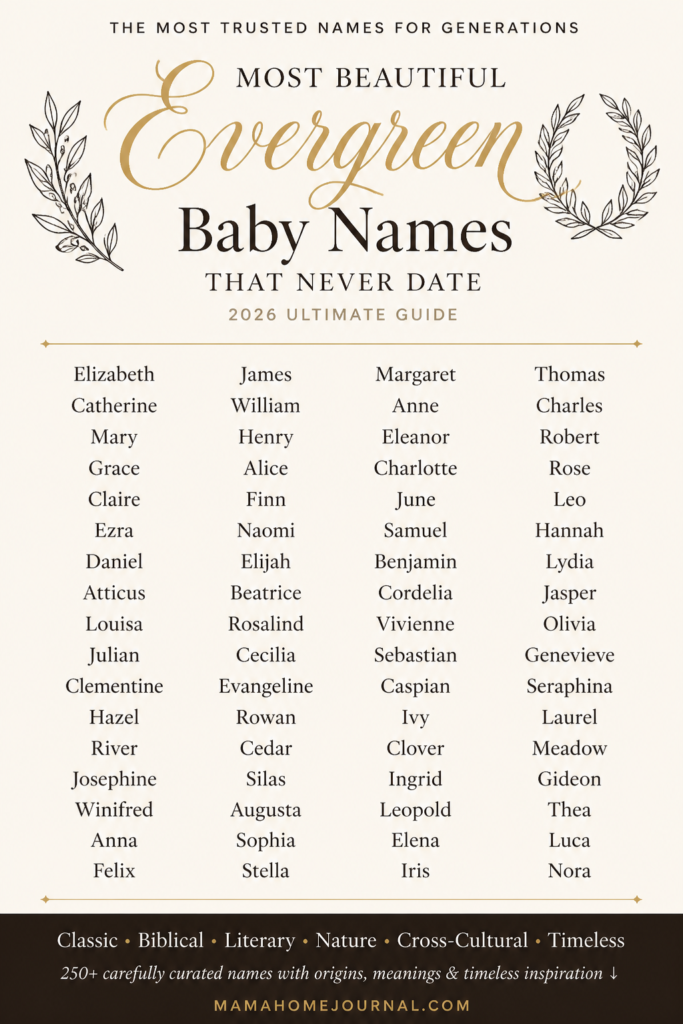
Quick-Reference Master Table: All 250+ Evergreen Baby Names
| # | Name | Category | # | Name | Category |
|---|---|---|---|---|---|
| 1 | Elizabeth | Pillars | 46 | Miriam | Biblical |
| 2 | James | Pillars | 47 | Ezra | Biblical |
| 3 | Margaret | Pillars | 48 | Naomi | Biblical |
| 4 | Thomas | Pillars | 49 | Caleb | Biblical |
| 5 | Catherine | Pillars | 50 | Samuel | Biblical |
| 6 | William | Pillars | 51 | Esther | Biblical |
| 7 | Anne | Pillars | 52 | Elijah | Biblical |
| 8 | Henry | Pillars | 53 | Benjamin | Biblical |
| 9 | Eleanor | Pillars | 54 | Sarah | Biblical |
| 10 | Alice | Pillars | 55 | Phoebe | Biblical |
| 11 | Grace | Pillars | 56 | Atticus | Literary |
| 12 | Charlotte | Pillars | 57 | Beatrice | Literary |
| 13 | Rose | Pillars | 58 | Dorian | Literary |
| 14 | Mary | Pillars | 59 | Cordelia | Literary |
| 15 | Claire | One Syllable | 60 | Jasper | Literary |
| 16 | Finn | One Syllable | 61 | Ambrose | Literary |
| 17 | June | One Syllable | 62 | Louisa | Literary |
| 18 | Eve | One Syllable | 63 | Rosalind | Literary |
| 19 | Leo | One Syllable | 64 | Emmett | Literary |
| 20 | Ruth | One Syllable | 65 | Vivienne | Literary |
| 21 | Wren | One Syllable | 66 | Olivia | Melodic |
| 22 | Cole | One Syllable | 67 | Julian | Melodic |
| 23 | Mae | One Syllable | 68 | Cecilia | Melodic |
| 24 | Tess | One Syllable | 69 | Sebastian | Melodic |
| 25 | Bram | One Syllable | 70 | Evangeline | Melodic |
| 26 | Gwen | One Syllable | 71 | Genevieve | Melodic |
| 27 | Max | One Syllable | 72 | Clementine | Melodic |
| 28 | Beau | One Syllable | 73 | Valentina | Melodic |
| 29 | Reid | One Syllable | 74 | Caspian | Melodic |
| 30 | Seth | One Syllable | 75 | Ivy | Nature |
| 31 | Nell | One Syllable | 76 | Rowan | Nature |
| 32 | Rex | One Syllable | 77 | Hazel | Nature |
| 33 | Eli | One Syllable | 78 | Fern | Nature |
| 34 | Owen | One Syllable | 79 | River | Nature |
| 35 | Lois | One Syllable | 80 | Sage | Nature |
| 36 | Hannah | Biblical | 81 | Reed | Nature |
| 37 | Jonah | Biblical | 82 | Cedar | Nature |
| 38 | Daniel | Biblical | 83 | Laurel | Nature |
| 39 | Abigail | Biblical | 84 | Birch | Nature |
| 40 | Rachel | Biblical | 85 | Clover | Nature |
| 41 | Isaac | Biblical | 86 | Thea | Quiet Cool |
| 42 | Noah | Biblical | 87 | Gideon | Quiet Cool |
| 43 | Lydia | Biblical | 88 | Josephine | Quiet Cool |
| 44 | Tobias | Biblical | 89 | Silas | Quiet Cool |
| 45 | Matthias | Biblical | 90 | Ingrid | Quiet Cool |
How to Choose a Name From This List
Start with sound, not meaning. Say the full name — first, middle, last — out loud slowly. Then say it fast, the way you will say it at a playground. Then say it tired, at six in the morning when everything feels impossible. The names that survive all three tests are the ones that work.
Consider what the name does at different ages. A name that sounds sweet on a three-year-old but feels wrong on a forty-year-old is doing only half its job. Most names on this list have been worn by adults for centuries — that is part of why they made the list — but it is still worth picturing your child at twenty-five before you decide.
Think about the nickname landscape. Some of these names are perfect standalone and nicknames feel imposed (Rose, Seth, Eve). Others have rich nickname families built in — Elizabeth into Bess, Eliza, Libby, Betsy; Benjamin into Ben, Benny, Benji. Neither is better, but knowing which you are choosing helps enormously.
Do not over-index on current popularity data. Evergreen names oscillate within a relatively narrow band — they rise and fall without ever disappearing or exploding. A name that is #42 this year might be #18 in five years, but it will not suddenly fill every classroom. The density problem is a trend problem, and these names simply do not do that.
Finally — meaning matters less than it seems in the moment, and more than it seems over time. You probably will not explain the meaning to most people who ask the name. But somewhere around age eight, your child will ask you why you chose it — and it is a better conversation if the answer is genuinely specific.
Frequently Asked Questions
What actually makes a baby name evergreen?
An evergreen name has two properties working together: phonetic stability and cultural depth. Phonetic stability means the name does not rely on a sound trend — it does not rhyme with five other names from the same decade. Cultural depth means the name is rooted in scripture, classical mythology, or literary tradition, giving it weight that outlasts any single generation’s taste.
Will these names feel boring compared to more unique options?
Only if you choose them passively. An Eleanor chosen because you love Eleanor of Aquitaine, the sound, and the nickname Nell is a deeply considered name. An Eleanor chosen because it is safe might feel that way. The difference is not in the name — it is in the relationship you build with it.
How do I know if a name will still sound good in forty years?
Look backward, not forward. Find out how old the name is and whether it was used continuously or in waves. A name that has been in steady, unspectacular use for five hundred years — never the top name, never completely absent — is almost certainly going to keep behaving exactly that way.
Can I combine an evergreen first name with a more unique middle name?
Yes, and it is one of the best naming strategies available. A grounded, legible first name gives your child a reliable everyday identity, while the middle name can hold anything — a family name, something unusual, a longer form you loved but found too much for daily use. Henry Lysander. Clara Isadora. Edmund Rafferty.
Are biblical names only for religious families?
No. Biblical names are among the oldest documented names in the world, and they have been used by secular and religious families alike for centuries. Ezra, Naomi, Caleb, and Miriam are used in Jewish, Christian, Muslim, and secular households across every continent without requiring any particular religious practice.
Final Thoughts
The best names are not the ones that announce themselves. They are the ones that quietly become inseparable from the person wearing them — until you cannot imagine the name without the person or the person without the name. Every name on this list has done that job, somewhere, for someone, for a very long time.
You are not choosing safe. You are choosing durable. There is a difference, and it matters across a whole lifetime.